
The Heat Safety Challenge Specific to Road Work
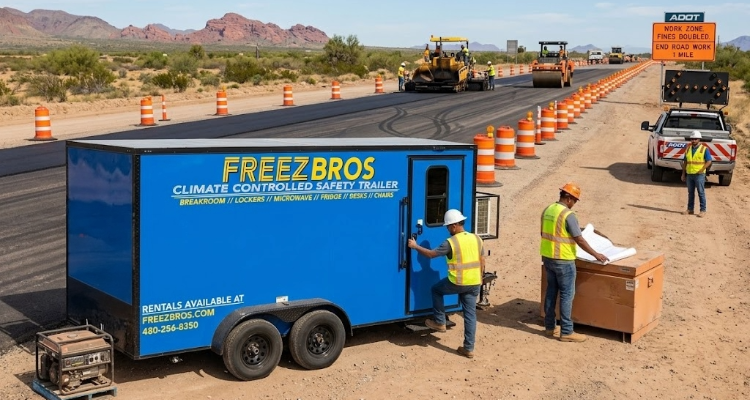
Construction workers face heat every summer in Arizona. Road crews face something worse: they work on the hottest surface in the state — asphalt — in the most exposed terrain available, often in remote locations with no facilities, no shade structures, and no buildings within miles.
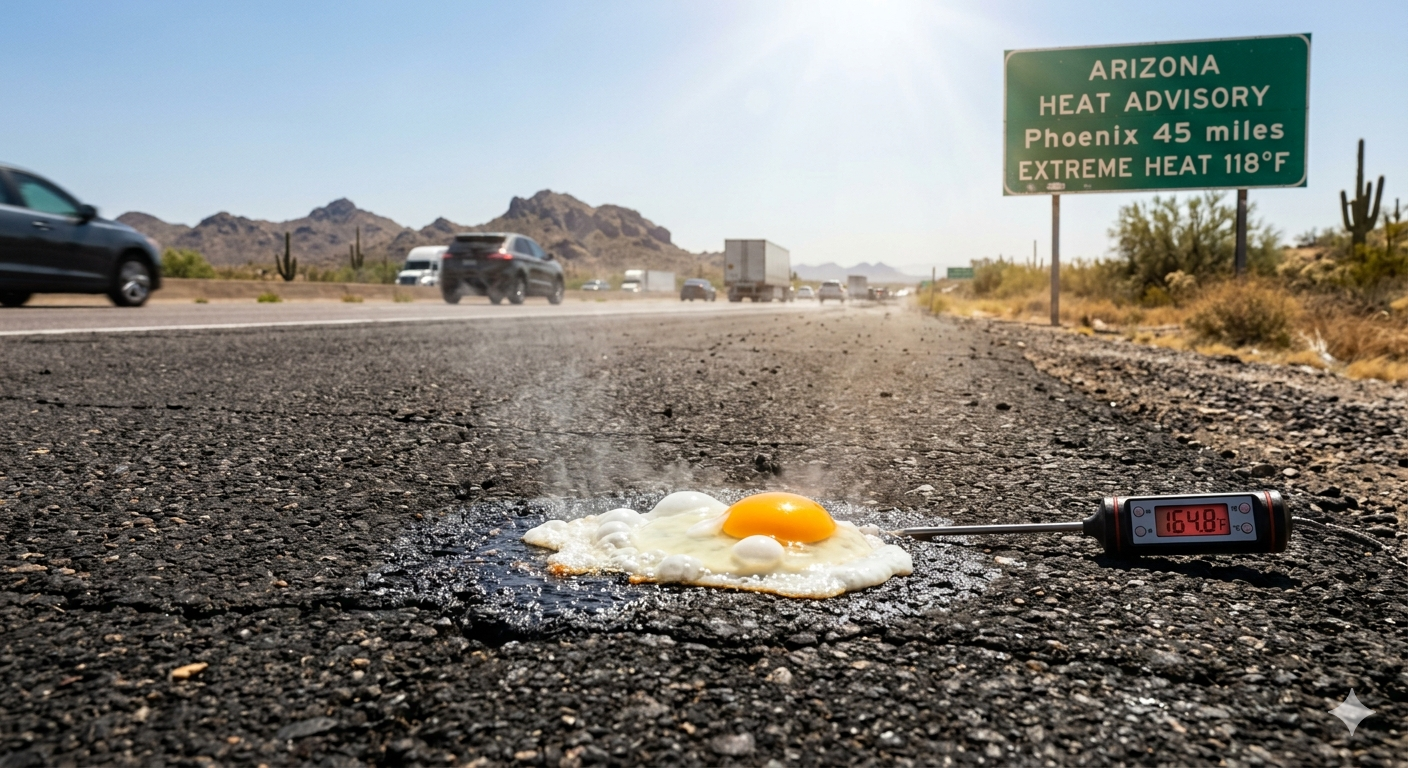
A highway resurfacing crew on I-10 west of Phoenix in July is working in ambient air temperatures of 115°F+, on asphalt surfaces at 160°F+, with no natural shade, surrounded by radiant heat from the roadway itself. Standard heat safety advice — "find shade, drink water" — has no practical application in this environment. There is no shade. The water truck can't keep up with extreme sweat loss. And the nearest facility is miles away.
ADOT Project Requirements for Heat Safety
The Arizona Department of Transportation (ADOT) and contractors working on federal and state highway projects in Arizona must comply with OSHA's heat standards, and increasingly, ADOT project specifications include explicit heat safety plan requirements as a contract condition.
On ADOT projects, heat illness prevention plans are submitted as part of the contractor's safety plan and reviewed before work begins. These plans must address:
- Rest area specification — ADOT reviewers are increasingly familiar with the inadequacy of shade tents on exposed roadway projects and are requiring active cooling solutions
- Work/rest schedules — documented and enforced, with specific requirements for high-heat periods
- Emergency response procedures — including nearest hospital location and transport plan, which on remote highway projects requires specific planning
- Water and electrolyte provision — quantities specified, not just "provide water"
- Heat safety training documentation — all workers, all subcontractors, before mobilization
When submitting your heat illness prevention plan for an ADOT project, specifying a climate-controlled safety trailer as your rest area solution — with the BTU rating and interior temperature specification — gives your plan immediate credibility. Reviewers who have seen "shade tent" plans know they don't work and will ask questions. A 70°F climate-controlled unit is an answer that closes the question.
Positioning and Logistics for Highway Work Zones
Unlike construction sites with a defined perimeter and access points, highway work zones are linear — crews might be working along a half-mile or two-mile stretch of road. The trailer needs to be positioned to minimize the time workers spend walking from their work area to the rest area, because time spent walking in 115°F sun is not rest.
Practical positioning strategies used by Arizona road crews:
- Mobile positioning — the trailer is moved every few hours as the active work zone shifts. With a truck and trailer, repositioning takes 10 minutes and the rest area stays within 5 minutes' walk of the crew
- End-of-zone staging — for crews working toward a fixed endpoint (paving from one interchange to another), the trailer is staged at the end point and workers rotate back to it on scheduled breaks
- Generator-powered independence — highway right-of-way doesn't have electrical hookups. The generator add-on makes the trailer fully self-contained wherever it's parked
Night Work: Still Hot, Still Needs Compliance
Many Arizona highway projects shift to night work during summer to avoid the worst daytime heat — and ADOT often specifies night work windows as a condition on certain project types. Night work is cooler, but "cooler" in Arizona summer means 85–95°F at midnight, still well above the threshold that triggers OSHA heat requirements.
Night crews still need access to a cooled rest area, still need water, and still need documented breaks. The trailer works equally well for night shifts — the A/C runs, the lighting inside provides a useful work environment for briefings, and the refrigerator keeps water cold throughout the night.
A Freez Bros trailer on a night-shift highway project also serves as your crew's briefing room and documentation hub. Running daily JSAs and plan reviews in a lit, climate-controlled environment at the start of a night shift is significantly better than doing it on a clipboard in the dark on the shoulder of a highway.
Protect Your Crew. Stay Compliant. Book Today.
Arizona heat season is here. Freez Bros climate-controlled trailers are available now across the Phoenix metro and statewide. Units book up fast as summer peaks — check availability for your project now.