
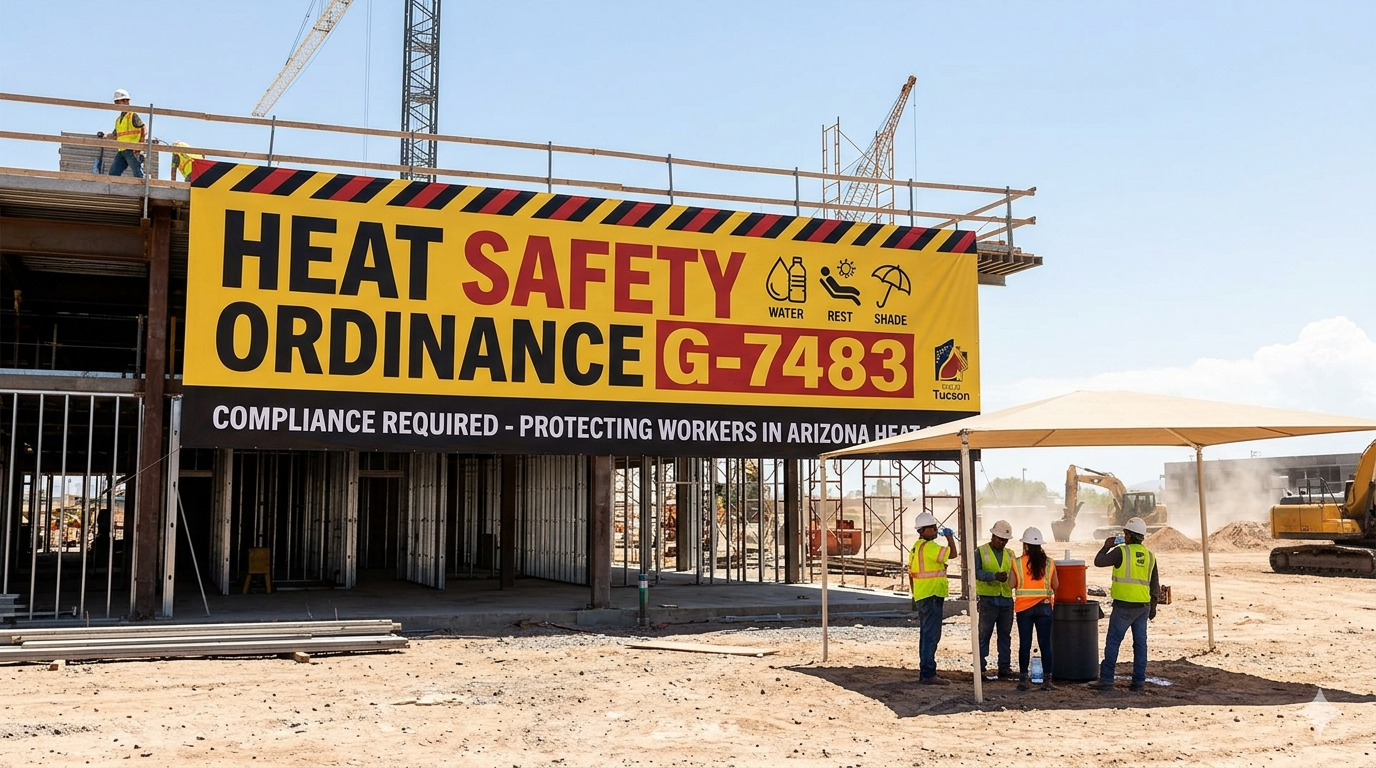
What Is G-7483 and Who Does It Apply To?
Phoenix Ordinance G-7483 is a city-level heat safety law passed in response to Arizona's alarming rate of outdoor worker heat deaths. It applies to all employers conducting outdoor work within the City of Phoenix — including construction, landscaping, road work, utilities, solar installation, and any other trade where workers spend significant time outdoors during warm months.
The ordinance is enforced by the City of Phoenix and operates independently of federal OSHA. That means you can receive a G-7483 citation even if OSHA hasn't visited your site, and you can receive an OSHA citation even if Phoenix hasn't. The two enforcement bodies are separate — and both are active.
The Complete G-7483 Compliance Checklist
Use this checklist for your daily site walkthrough. Every item must be in place before workers start their shift.
✅ Requirement 1 — Cool Drinking Water
- Cool, potable water is available and accessible to all workers at all times — not just at the start of shift
- Water stations are positioned so no worker has to walk more than 1 minute to reach one
- Water is actually cool — stored in a shaded or climate-controlled location, not baking in the sun
- Sufficient quantity for one quart per worker per hour during high heat periods
✅ Requirement 2 — Actively Cooled Rest Area
- A shade tent or canopy alone does not satisfy this requirement when ambient temps exceed 100°F
- Rest area must provide active cooling that meaningfully reduces workers' core body temperature
- Space must accommodate the number of workers taking breaks simultaneously
- Rest area is accessible — not locked, not a long walk from the work area
The "actively cooled rest area" is where the majority of Phoenix contractors are currently non-compliant. A shade tent in 115°F heat can still reach 95–105°F interior temperature — providing no meaningful core temperature recovery. Inspectors know this and are documenting it as violations.
✅ Requirement 3 — Written Heat Illness Prevention Plan
- Written plan exists and is physically present on the job site (not just on someone's laptop)
- Plan is written in the primary language(s) of your workforce
- Plan is reviewed with the full crew at the start of each shift during high-heat periods
- Review is documented with date, time, and worker sign-offs
- Plan includes emergency response procedures (who calls 911, nearest ER address)
✅ Requirement 4 — Mandatory Rest Periods
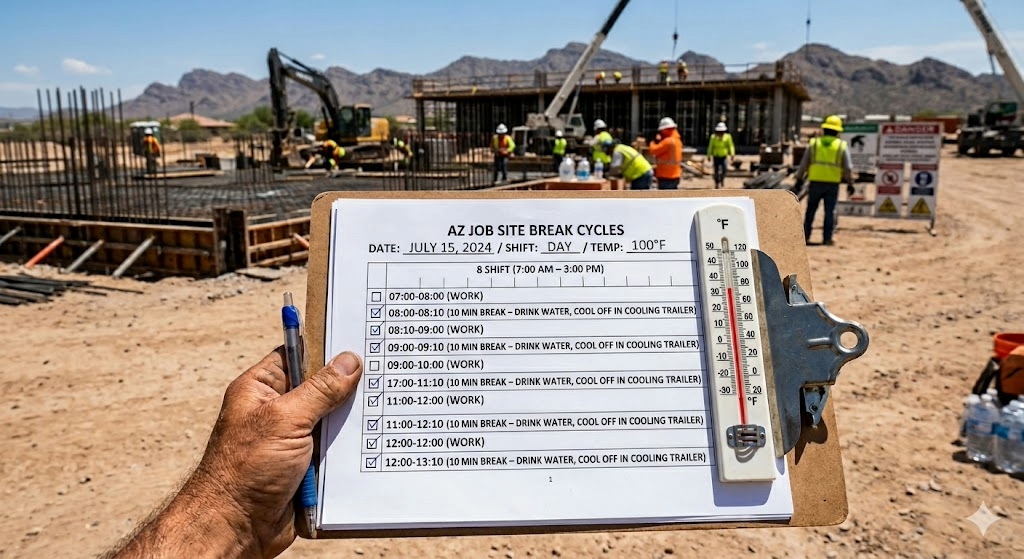
- Structured rest breaks are scheduled and enforced — not left to worker discretion
- Break schedule is posted or communicated clearly at the start of shift
- Supervisors are responsible for ensuring workers actually take their breaks
- Break periods are spent in the cooled rest area — not sitting in a truck with the engine running
✅ Requirement 5 — Heat Safety Training
- All workers have received documented heat illness prevention training before starting work on-site
- Training covers: symptoms of heat stress, heat exhaustion, and heat stroke
- Training covers: what to do if a coworker shows symptoms (buddy system)
- Training is conducted in workers' primary language
- Sign-off sheets are retained on-site for inspector review
✅ Requirement 6 — First Aid Resources On-Site
- Stocked OSHA-compliant first aid kit is accessible on-site
- Eye wash station is available (required under OSHA 29 CFR 1910.151)
- At least one worker per shift has current first aid / CPR certification
- Emergency response card is posted with nearest ER address and 911 protocol
What Happens If an Inspector Shows Up
Phoenix enforcement officers and OSHA inspectors conducting Heat NEP inspections will typically do the following when they arrive at your site:
- Ask to speak with the site supervisor or foreman immediately
- Request your written Heat Illness Prevention Plan — they want to see it physically on-site
- Walk the site to observe water stations, rest areas, and worker conditions
- Interview workers — asking if they've been trained, if they know where to get water, and if they know the symptoms of heat illness
- Ask to see training sign-off records
- Evaluate whether the rest area provides actual cooling or just shade
If your rest area is a shade tent, that last item is where the citation happens. Inspectors in Arizona know what 115°F ambient temperature looks like and they know a tent doesn't cool anyone down.
Keep a compliance binder in your rest area — not in your truck. It should contain your written Heat Illness Prevention Plan, training sign-off sheets, and your emergency response card. When an inspector asks for documentation, you hand them the binder immediately. Sites that can't produce documentation on the spot get cited even when they're otherwise doing things right.
How One Trailer Checks Every Box
The most efficient way to satisfy G-7483 is to have a climate-controlled rest area that doubles as your training and documentation space. A Freez Bros safety trailer running the 18,000 BTU Della Vario mini-split achieves a consistent 70°F interior — checking the "actively cooled" requirement definitively.
The whiteboard walls let you run your daily plan review and sign workers in. The built-in first aid kit and eye wash station cover your first aid requirement. The refrigerator keeps water cold. The seating accommodates your full crew on rotation.
One rental. Six boxes checked. That's not marketing — that's the checklist math.
Get Every Box Checked Before Your Next Shift.
A Freez Bros climate-controlled trailer puts a G-7483 compliant rest area, first aid station, and training room on your site in one delivery. Units are available now across the Phoenix metro. Don't wait until you get cited to get compliant.