
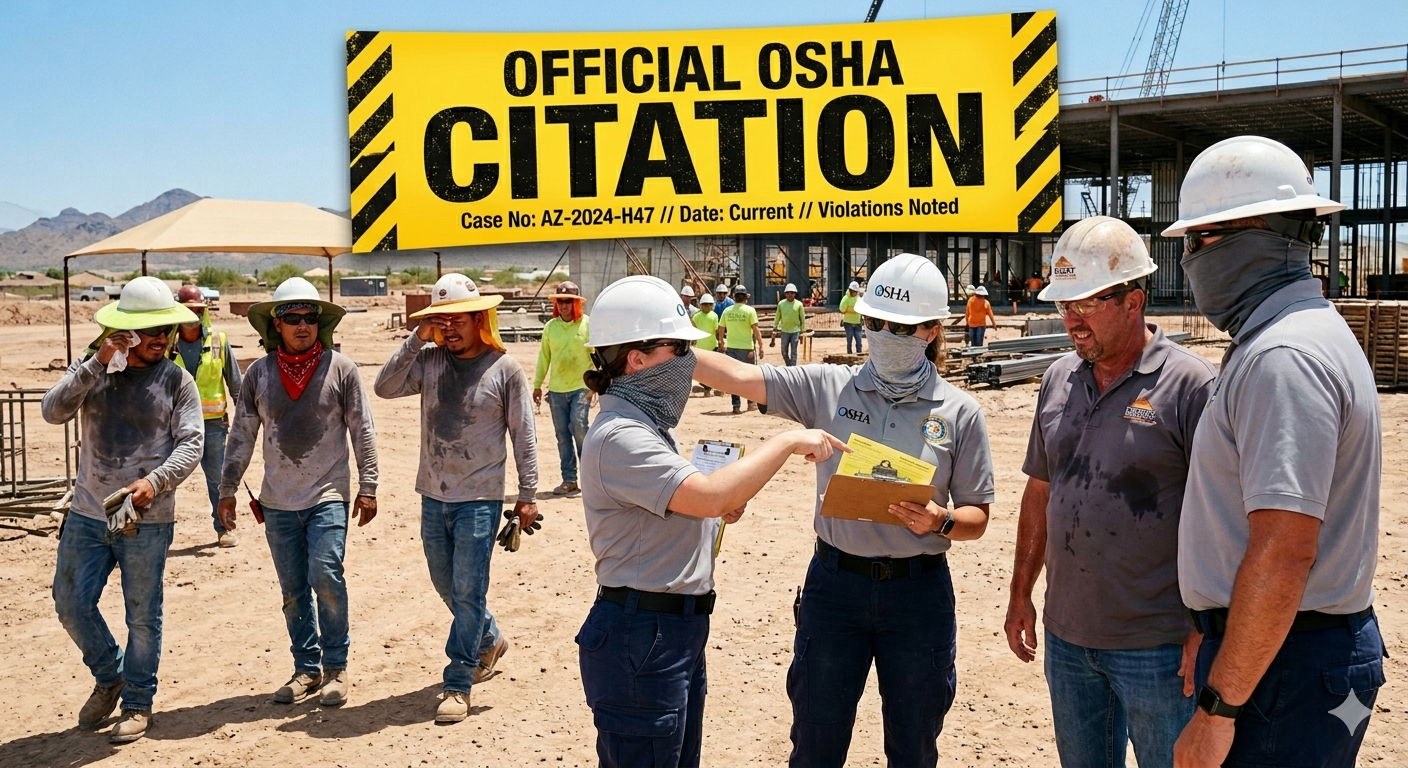
Understanding the Heat NEP: Why Inspectors Don't Need a Reason
Most contractors understand that OSHA shows up after a complaint or an accident. The Heat National Emphasis Program (NEP) changed that. Under the NEP, OSHA area offices in high-heat regions — which includes all of Arizona — are authorized to conduct proactive, unprogrammed inspections at outdoor job sites when heat conditions are elevated.
In practice, that means an inspector can pull up to your site on a 108°F Tuesday afternoon with no complaint filed, no incident reported, and no prior notice. They have the authority to walk your site, speak with your workers, and request your documentation on the spot.
If you can't produce it — or if what they find doesn't meet the standard — citations are issued that day.
What OSHA Inspectors Actually Look For
Based on the NEP inspection protocol and enforcement patterns in Arizona, here is the precise order of what an inspector evaluates when they arrive at your site:
Step 1: They Talk to Your Workers First
Before they ask for any paperwork, inspectors walk the site and talk to workers directly. They ask simple questions: Do you know the signs of heat stroke? Where do you go if you're feeling sick from the heat? When did you last have a break? Have you received heat safety training?
Workers who don't know the answers — or who point to a shade tent as their rest area — are your first liability. If your workers can't answer basic heat safety questions, citations follow.
Step 2: They Evaluate Your Rest Area
The inspector will physically go to your rest area and assess it. A shade tent on a 115°F day can read 95–105°F inside. They know this. They also know that a worker cannot meaningfully recover their core temperature during a 10-minute break in 98°F shade.
What passes inspection is an enclosed, air-conditioned space — a site trailer, a climate-controlled safety trailer, a building interior — that is measurably cooler than ambient conditions and large enough to accommodate the number of workers on rotation.
Step 3: They Ask for Your Written Plan
Your Heat Illness Prevention Plan must be physically present on-site. Not on your phone. Not at the office. On site. It must include: emergency procedures, identification of high-heat conditions, training protocols, acclimatization schedules, and water/rest requirements. If you can't produce it within minutes, that's a citation.
Step 4: They Review Training Records
You need sign-off sheets showing every worker on site has received documented heat safety training. The date of training must be on the form. The worker's name and signature must be on the form. If a worker has been on site for three months and there's no training record for them, that's a serious violation.
Step 5: They Check Water Access
Is there cool water accessible without workers having to walk across the site? Is there enough of it? Is it actually cool, or is it a lukewarm jug sitting in direct sun? All three matter.
The most common Arizona heat citation package includes: (1) inadequate rest area — a shade tent or truck cab cited as insufficient, (2) no written plan on-site, and (3) no training documentation. These three together often result in citations totaling $20,000–$45,000 for a first inspection.
How to Be Ready Every Day — Not Just When You Expect an Inspection
The contractors who don't get cited aren't the ones scrambling to get compliant before an inspector shows up — they're the ones who built compliance into their daily site routine. Here's what that looks like:
Morning Protocol (Before First Tool Is Picked Up)
- 5-minute tailgate meeting — heat illness plan reviewed, that day's heat index shared, buddy system assigned
- Sign-in sheet completed — every worker present signs in, confirming they've been briefed on the plan
- Water stations checked — cool water confirmed accessible at multiple points on site
- Rest area confirmed operational — A/C running and at temperature before first break
- Compliance binder in rest area — plan, training records, and emergency card physically in the rest area
During the Shift
- Supervisors enforce rest periods — workers don't opt out of breaks
- Someone is designated to monitor workers for heat illness symptoms throughout the day
- New workers (first 14 days) are on a modified schedule with more frequent breaks and reduced heat exposure
Stay calm. Walk them to your rest area first — let it speak for you. Hand them your compliance binder. Don't argue about whether your shade tent qualifies; if you have a real cooled rest area, the inspection resolves itself quickly. Inspectors who find compliant sites typically close the inspection in under an hour with no citations.
The Fastest Path to Full Compliance
The rest area is the hardest item to fix quickly because it's physical infrastructure. You can write a heat plan tonight. You can print training sign-off sheets tomorrow morning. But you can't build a cooled rest area in an hour.
A climate-controlled safety trailer is the fastest path to full compliance because it solves the hardest problem — the rest area — and provides the physical space to run your daily briefings and store your compliance binder. From the moment it's delivered and powered up, your site has a defensible, inspector-ready rest area.
Be Ready Before They Show Up.
Don't wait for an inspector to tell you your shade tent isn't enough. A Freez Bros climate-controlled safety trailer gives your site a compliant, documented, inspector-ready rest area the day it's delivered. Units are available now across the Phoenix metro — check availability before your project kicks off.