
Why 2026 Is Different
Arizona contractors have always known that summer heat is dangerous. But for years, federal OSHA's heat safety requirements were scattered across general duty clause citations and informal guidance — not an enforceable standard with clear numbers attached.
That changed. OSHA's Heat Injury and Illness Prevention in Outdoor and Indoor Work Settings rule has been advancing through the rulemaking process, and in parallel, the agency launched a National Emphasis Program (NEP) on heat that gives inspectors authority to show up at job sites — without a complaint — whenever temperatures hit certain thresholds. In Arizona, that threshold is crossed almost every day from May through September.
Simultaneously, the City of Phoenix enacted Ordinance G-7483, which is already in effect and carries its own enforcement mechanism separate from federal OSHA. If you're running outdoor work anywhere in Phoenix, you are subject to both.
OSHA's Heat NEP means inspectors can conduct unprogrammed inspections at outdoor job sites when the heat index exceeds 80°F — which in Arizona means most of the year. You do not have to receive a complaint for an inspector to show up.
What Federal OSHA Now Requires
Under the NEP and advancing rulemaking, OSHA inspectors are evaluating outdoor employers against these core requirements when temperatures are high:
1. Access to Cool Water
Workers must have access to cool, potable drinking water at all times — not just a cooler baking in the sun. OSHA guidance recommends one quart of water per hour for workers in high heat. The water must be accessible, not locked in a truck or requiring a walk across the site.
2. A Real, Cooled Rest Area
This is the one most contractors get wrong. OSHA requires access to a cool, shaded rest area — but shade alone is increasingly insufficient in Arizona's extreme dry heat. When ambient temperatures exceed 100°F, shaded areas can still hit 95°F+, which does not provide meaningful cooling for core body temperature recovery.
Inspectors are now specifically noting whether the rest area provides active cooling, not just shade. A tent or canopy does not meet the spirit of this requirement in Phoenix in July.
3. Acclimatization Protocol
New workers and returning workers must be acclimatized to heat gradually. OSHA recommends a structured ramp-up — typically 20% of exposure time on day one, increasing over 7–14 days. You need a documented protocol and someone responsible for monitoring new hires during their first two weeks.
4. Heat Illness Prevention Plan
A written Heat Illness Prevention Plan must be on-site, accessible, and communicated to all workers. It must be in a language they understand. This isn't a form you fill out once and forget — it needs to be reviewed and signed by crew members.
5. Emergency Response Procedures
Your site must have a clear plan for what happens when a worker shows signs of heat exhaustion or heat stroke. This includes who calls 911, who stays with the worker, where the first aid kit is, and where the nearest emergency room is located. Inspectors will ask your foreman these questions directly.
6. Heat Safety Training
All workers must be trained to recognize the signs and symptoms of heat-related illness — in themselves and in coworkers. Training must be documented. OSHA inspectors will ask workers on-site if they've received training, and they'll ask your supervisors to produce records.
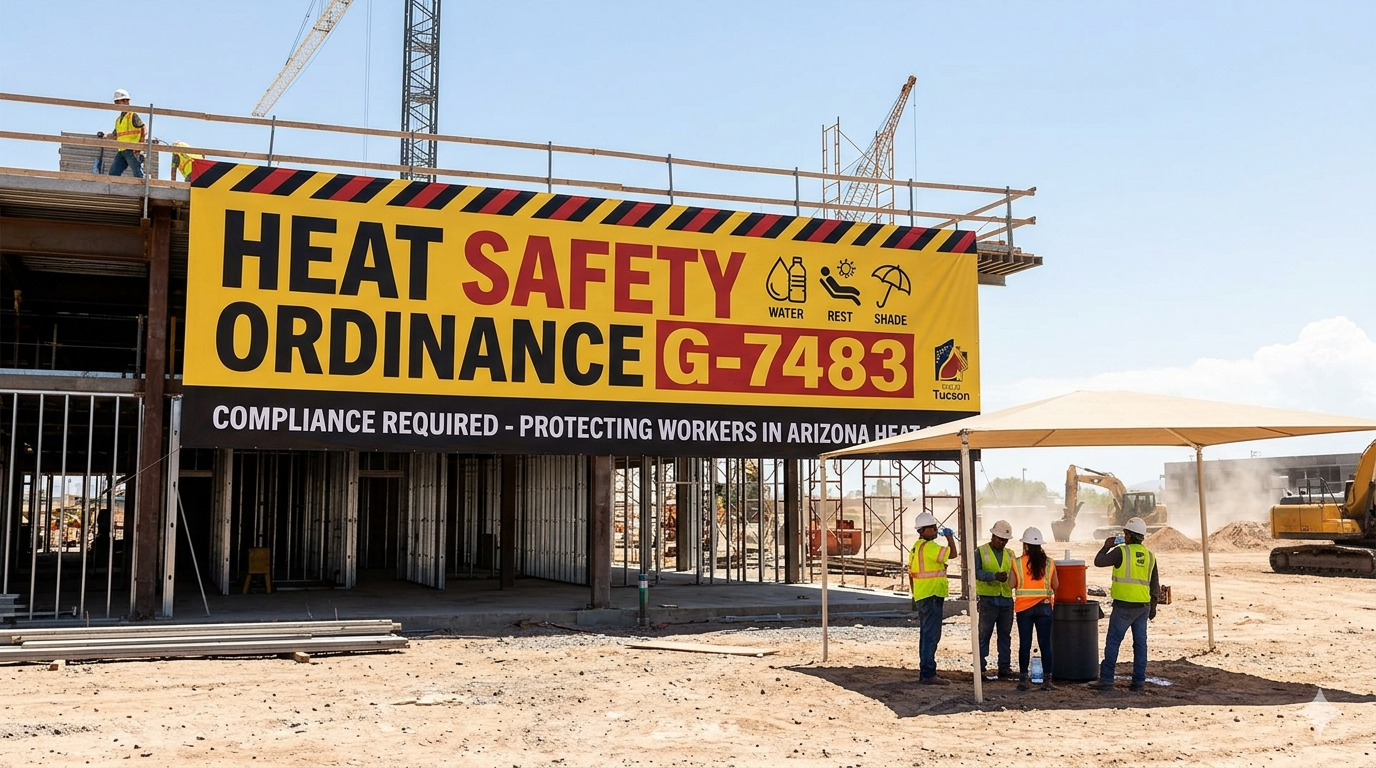
Phoenix Ordinance G-7483: Arizona's Own Layer of Enforcement
On top of federal OSHA requirements, Phoenix contractors face a city-level ordinance that is already enforceable. G-7483 was passed specifically because Arizona's heat deaths among outdoor workers are among the highest in the nation.
G-7483 requires all outdoor contractors working within Phoenix city limits to provide:
- Cool drinking water — readily accessible throughout the shift
- Actively cooled rest area — a tent does not qualify. The rest area must provide meaningful temperature reduction
- Documented Heat Illness Prevention Plan — on-site, reviewed daily with crew
- Mandatory rest periods — enforced, not optional, during high-heat hours
- Heat safety training — documented, in workers' primary language
- First aid resources — stocked and accessible on-site at all times
G-7483 specifically requires an actively cooled rest area — not shade. A shade canopy, misting fan, or swamp cooler does not satisfy this requirement when ambient temperatures exceed 100°F. The ordinance is written to require a space that actually lowers workers' core body temperature during breaks.
The Fine Structure: What Non-Compliance Actually Costs
| Violation Type | Federal OSHA Fine | Phoenix G-7483 Fine |
|---|---|---|
| Other-than-serious | Up to $1,190 | Varies |
| Serious violation | Up to $15,625 | Up to $2,500 |
| Willful / Repeat violation | Up to $156,259 | Up to $15,625 |
| Failure to abate | Up to $15,625/day | Compounding |
Those numbers compound fast. A single site inspection that identifies multiple violations — no written plan, no cool rest area, no documented training — can result in citations exceeding $50,000 for a first-time inspection. A repeat inspection where you haven't corrected prior violations pushes into six figures.
Beyond fines: if a worker suffers heat stroke and dies, OSHA investigates every aspect of your heat safety program. Criminal referrals are rare but possible when egregious negligence is found.
What a Compliant Site Looks Like in Practice
Contractors who are passing OSHA heat inspections in Arizona in 2026 typically have the following in place:
- A climate-controlled rest area — most commonly a cooling trailer with a functioning A/C system. This is the single most impactful item on the list because it satisfies the rest area, water cooling, and first aid requirements simultaneously.
- Daily tailgate meetings — 5–10 minutes at the start of every shift reviewing the heat illness prevention plan, buddy system, and that day's heat index forecast.
- Posted water stations — multiple locations on site, not just one cooler. In heat this extreme, workers shouldn't have to walk more than a minute to access water.
- Documented acclimatization logs — a simple form tracking new hires through their first two weeks, signed by their supervisor each day.
- Emergency response card — laminated, posted in the rest area and at the site entrance. Includes the nearest ER address, who calls 911, and first aid steps for heat exhaustion and heat stroke.
- Training sign-off sheets — proof that every worker on-site received heat safety training, with their signature and the date.
A single Freez Bros climate-controlled trailer on your job site satisfies the rest area, water cooling, first aid, and training space requirements in one rental. The 18,000 BTU mini-split maintains a consistent 70°F interior — dramatically exceeding what any shade structure or evaporative cooler can provide at 115°F ambient. The whiteboard walls let you run your daily JSA and document your heat illness prevention plan review right on-site.
The Bottom Line for Arizona Contractors
Heat regulation enforcement in Arizona is no longer theoretical. Inspectors are on job sites. Fines are being issued. Workers are dying, and regulators are responding with real enforcement pressure.
The good news: compliance isn't complicated. It requires a written plan, documented training, water access, and — most critically — a real cooled rest area. Get those four things right and your site can pass an inspection without warning.
The bad news: the "real cooled rest area" requirement is where most Arizona contractors are still cutting corners. A tent in 115°F heat is not a rest area. It's a liability waiting to happen.
Don't Wait for an Inspector to Show Up.
A Freez Bros climate-controlled safety trailer satisfies every OSHA and G-7483 rest area, first aid, and training requirement — with one rental. Units are booking up fast as summer approaches. Check availability now and lock in your site's compliance before the heat peaks.