
What OSHA Actually Requires for Rest Periods
Under OSHA's Heat NEP and advancing rulemaking, mandatory rest periods during high-heat conditions are a core requirement. The standard builds on NIOSH (National Institute for Occupational Safety and Health) guidelines for work/rest ratios based on environmental heat load and physical exertion level.
In simple terms: the hotter it is and the harder people are working, the more frequent and longer the rest breaks must be. And critically, those rest breaks must be spent in a cooled environment — not just out of direct sun.
A 10-minute break in a shade tent at 105°F ambient does not constitute a rest period under OSHA's heat standard. The body cannot recover core temperature meaningfully in an environment that's still above 95°F. OSHA inspectors are now specifically evaluating whether rest areas provide actual cooling, not just shade.
NIOSH Work/Rest Ratios for Arizona Summer Conditions
NIOSH provides work/rest ratio recommendations based on the Wet Bulb Globe Temperature (WBGT) — a measure that accounts for temperature, humidity, radiant heat, and air movement. In Phoenix in July, WBGT readings routinely fall in the "high" to "very high" categories. Here's how that translates to your site schedule:
Light Work (Office tasks, inspecting, supervising)
- Below 91°F WBGT: Normal schedule with water access
- 91–100°F WBGT: 45 min work / 15 min rest per hour
- Above 100°F WBGT: 30 min work / 30 min rest per hour
Moderate Work (Carpentry, masonry, concrete work, general labor)
- Below 88°F WBGT: Normal schedule with water access
- 88–100°F WBGT: 45 min work / 15 min rest per hour
- Above 100°F WBGT: 20–30 min work / 30–40 min rest per hour
Heavy Work (Demolition, trenching, heavy lifting, roofing)
- Below 86°F WBGT: Normal schedule with water access
- 86–98°F WBGT: 45 min work / 15 min rest per hour
- Above 98°F WBGT: 15–20 min work / 40–45 min rest per hour
On a Phoenix job site in July at 2 PM, ambient air temperature is typically 112–118°F. WBGT in full sun easily reaches 105°F or higher. This means most outdoor construction work in Arizona summer peaks falls into the highest-ratio rest requirement category — up to equal time resting and working for heavy labor.
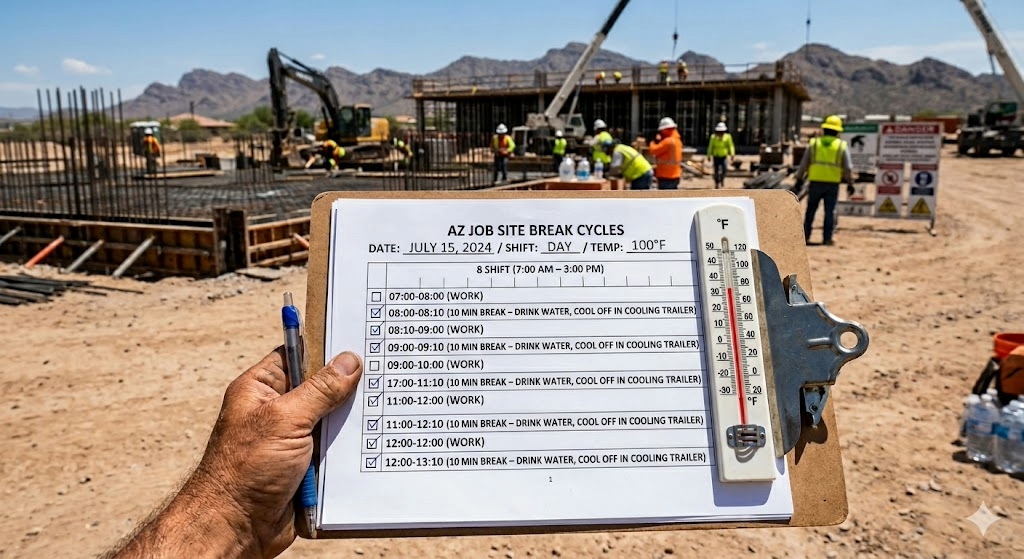
A Sample Compliant Break Schedule for an Arizona Day Shift
Below is a sample schedule for a standard 7 AM–3 PM day shift performing moderate-to-heavy construction work during Arizona summer peak conditions. This schedule is based on the G-7483 and NIOSH framework and reflects how compliant Phoenix-area contractors are structuring their days:
Why Break Schedules Actually Increase Daily Output
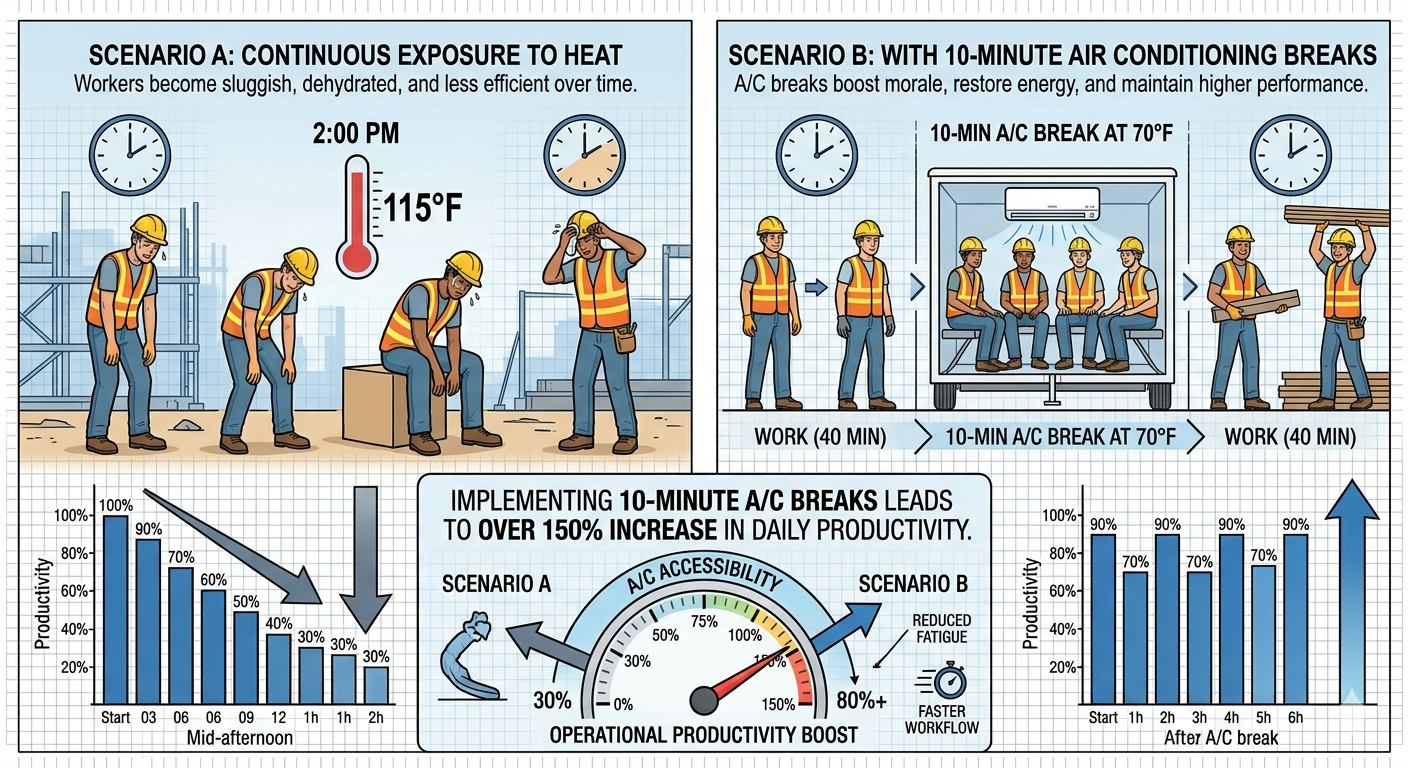
The instinct is that more breaks means less work getting done. The data says the opposite. A crew working without adequate rest in Arizona summer heat drops to roughly 30% of peak productivity by 2 PM. Mistakes increase. Injuries increase. Work quality drops. Arguments happen.
A crew with structured, compliant rest periods in a cooled environment maintains 80–90% productivity all day. The math is simple: two crews, same number of workers, same 8-hour shift — the crew with proper rest periods produces significantly more work, better work, and ends the day with fewer incidents.
The rest break is not time lost. It's maintenance on your most expensive equipment — your crew.
Making the Schedule Work on a Real Job Site
The practical challenge isn't knowing the schedule — it's enforcing it when there's pressure to push through and finish a pour or get a task done before a delivery arrives. Here's what works:
- Post the schedule visibly — on the trailer door, at the water station, at site entry. When it's visible, foremen and workers hold each other accountable
- Use a timer or site radio — announce breaks on the radio at the scheduled time. Removes the awkwardness of workers having to ask
- Plan tasks around breaks, not breaks around tasks — sequence heavy work in the cooler morning windows, save lighter coordination tasks for peak heat windows
- Make the rest area worth going to — a 70°F trailer with cold water and seating is actually a break. A tent is not. Workers who want to go to the rest area will take their breaks; workers who don't won't
- Document every break — keep a simple log. It takes 30 seconds and it's your paper trail if an inspector asks
Keep a simple break log in your compliance binder in the trailer. Each break period, the foreman or a designated crew member checks off the time and initials it. Takes 10 seconds. At end of day you have a documented record of every rest period for every shift. This is exactly what inspectors want to see.
Build Your Break Schedule Around a Trailer That Makes Breaks Worth Taking.
Workers take their rest breaks when the rest area is actually a break — 70°F, cold water, a seat. A Freez Bros trailer makes compliance easy because your crew actually wants to use it. Check availability for your project and lock in your unit before summer peaks.